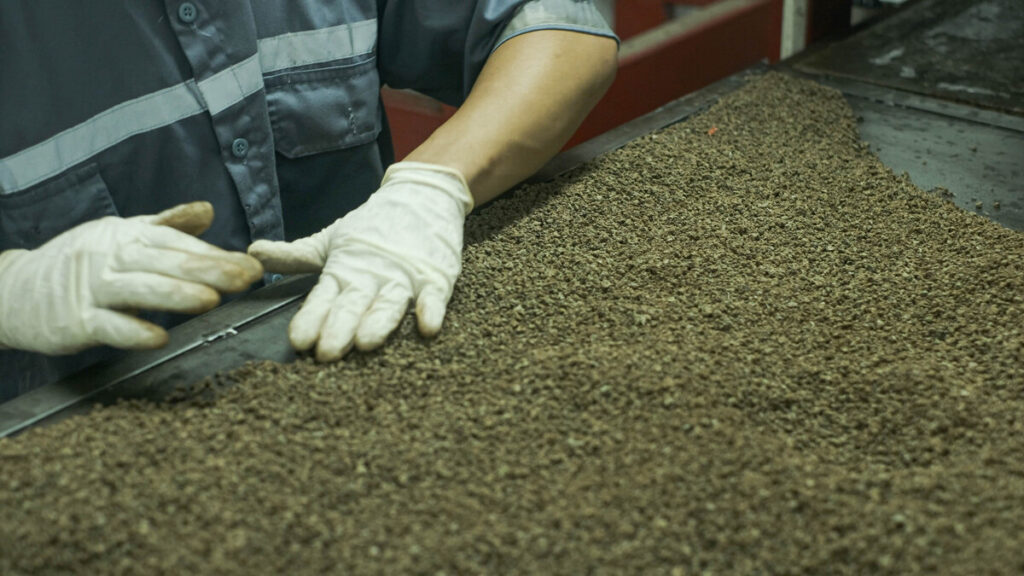
Not all waste has a second life. Residual waste, the material left over after people separate recyclable and compostable items, often ends up polluting the environment instead of going back to the value chain.
Ghost nets, fishing nets abandoned or discarded at sea, are one example. Made of durable synthetic plastics, they continue trapping marine life indefinitely. Because they are difficult to recycle, they are often overlooked and have little economic value.
For Rendy Aditya Wahid, founder of Parongpong RAW Lab, those are the kinds of problems worth paying attention to. Rather than starting with a material, he begins by identifying the problems worth solving. That way of thinking has influenced Parongpong RAW Lab from the beginning.
While studying material science, Rendy came across a Japanese research laboratory that funded its research by commercialising its own innovations. It left a lasting impression. When he later established Parongpong RAW Lab, he adopted a similar approach. The company would develop new materials through research, while the business itself would help fund the next round of innovation.
That idea also explains why Parongpong RAW Lab calls themself a research company instead of simply a recycling business. Every product starts with a question: is there a problem worth solving, and can research help solve it?
Today, Parongpong RAW Lab develops construction materials from residual waste, including Prototiles®, which is made from ghost nets. They also work with coastal communities to collect ghost nets, creating an additional source of income from materials that previously had little economic value.
The next challenge for the company now is preparing the business to produce more consistently while maintaining quality. Through the I-SEA program, Parongpong RAW Lab has been working on their product development, operations, and readiness to enter the retail market with support from IKEA thought partners.
Still, for Rendy, growth is not measured only by how many products the company sells. Is the business solving problems and making the world a livable place for the future generations? There will be many more problems as new environmental challenges surface. For Parongpong RAW Lab, the research simply continues.